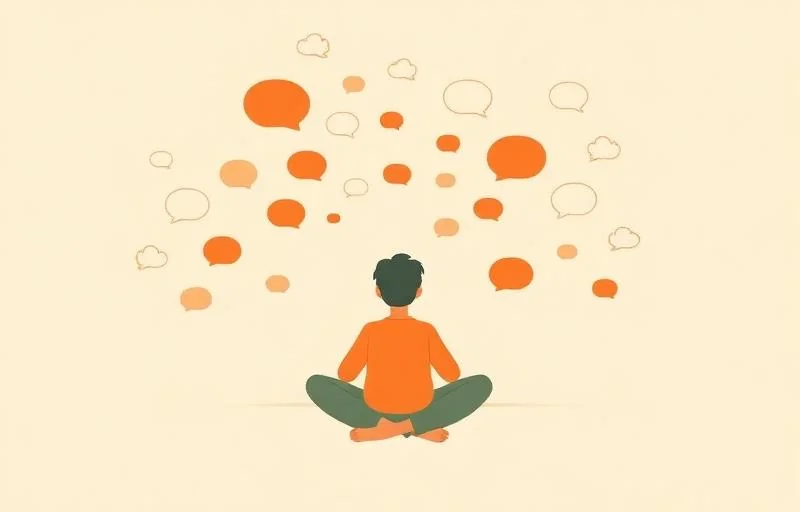

You have been productive. You have been disciplined. You have checked boxes, hit deadlines, and done everything right. And somehow you feel worse than when you started. Heavier. Emptier. More exhausted by the idea of another to-do list than by the work itself.
That is not failure. That is burnout asking for a reset.
The counterintuitive truth is that the fastest way forward is not more effort. It is a deliberate pause. Not collapse, not vacation, not scrolling on the couch. An intentional reset that lets you see clearly again.
What burnout actually is
Burnout is not just being tired. The World Health Organization classifies it as an occupational phenomenon defined by three dimensions: emotional exhaustion, depersonalization (feeling detached from your work and relationships), and reduced personal accomplishment.
Christina Maslach, the psychologist who pioneered burnout research, has shown that it is a systemic response, not a personal weakness. You do not burn out because you are not tough enough. You burn out because the demands on your system have exceeded your capacity to recover for too long.
This distinction matters. If burnout is a personal failing, the solution is to try harder. If burnout is a systemic response, the solution is to change the system. That starts with understanding what your mind and body are actually asking for.
Why "push through" advice makes it worse
Hustle culture has a simple prescription for burnout: discipline. Wake up earlier. Optimize your morning routine. Stack more habits. The message is that rest is laziness wearing a comfortable sweater.
Neuroscience tells a different story. Research on the default mode network shows that your brain does some of its most critical work during downtime: consolidating memories, processing emotions, connecting disparate ideas, and creative problem-solving. This is not idle time. It is maintenance time.
Skipping rest is like skipping oil changes. The car still runs, for a while. Then something breaks that costs far more to fix than the maintenance would have. Burnout is the engine light. Pushing through is ignoring it.
Rest is not the opposite of productivity. It is a prerequisite.
The power of an intentional reset
There is a difference between collapsing on the couch because you have nothing left and choosing to pause because you recognize the need. The first is reactive. The second is strategic.
An intentional reset is not about doing nothing. It is about doing something different: reflection instead of reaction, release instead of accumulation, recalibration instead of repetition.
The three components of an effective reset are simple. First, look inward: what is actually weighing on you? Second, release what is not serving you. Third, realign with what matters. Most burned-out people skip all three and go straight back to their to-do list. That is why the burnout keeps coming back.
Go Deep: asking the right questions
When you are burned out, you often cannot see the problem clearly. Everything feels heavy, but you cannot pinpoint why. A quick task list will not help here. You need depth, not speed.
This is where guided reflection becomes valuable. Instead of staring at a blank page wondering where to start, structured prompts can surface what is actually weighing on you. Questions like "What am I doing out of obligation rather than purpose?" or "What would I stop doing immediately if I had permission?" cut through the fog.
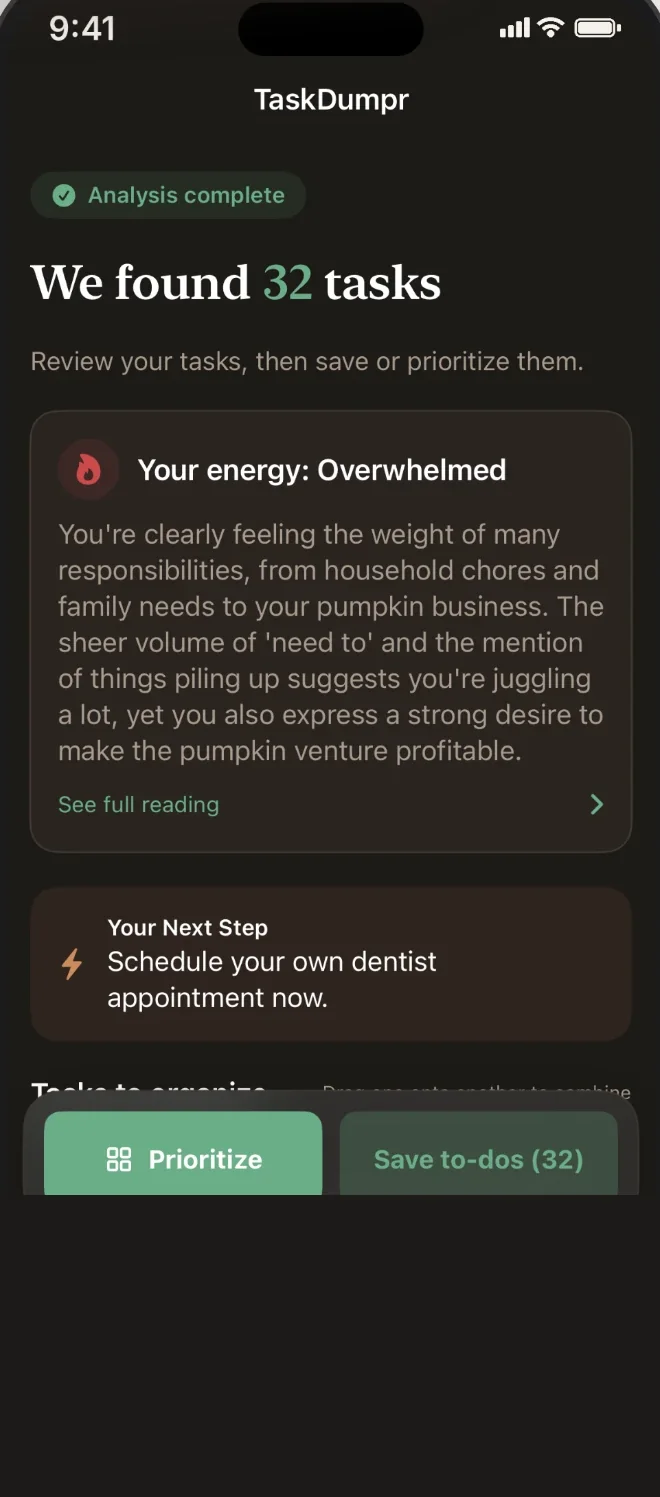
TaskDumpr's Go Deep mode is designed for exactly this. Unlike Quick Dump, which is built for speed, Go Deep prompts you with reflective questions that guide you past surface-level stress into the root causes. It is brain dumping with intention. Not "what do I need to do?" but "what do I need to understand?"
Research on expressive writing supports this approach. James Pennebaker's work at the University of Texas showed that writing about emotional experiences, especially when prompted to explore causes and feelings, leads to measurable improvements in mental health and cognitive function.
Take 10 minutes for a deep brain dump
Go Deep mode guides you through reflective prompts designed to surface what is really weighing on you. Start with clarity, not another to-do list.
Start a Go Deep sessionLet Go: releasing what is draining you
Burnout often comes from carrying things you should have dropped months ago. Obligations you agreed to out of guilt. Goals that no longer align with who you are. Other people's expectations that you adopted as your own. Projects that are going nowhere but feel impossible to quit.
These are not tasks to be managed. They are weights to be released. And most productivity systems have no mechanism for release. They only know how to hold, organize, and remind.
The practice of consciously letting go is one of the most underrated productivity strategies. It is not about giving up. It is about choosing what deserves your finite energy and dropping what does not.
TaskDumpr's Let Go feature gives you a dedicated space for this. Write down what you are releasing: the guilt, the obligation, the outdated commitment. Watch it symbolically float away. It is a small ritual, but rituals matter. They mark transitions. And that is exactly what a reset requires.
Building regular resets into your routine
A reset should not be something you do when you are already burned out. It should be a regular practice that prevents burnout from taking hold.
- Weekly:A 10-minute brain dump to clear accumulated clutter. Quick Dump mode, no pressure. Just empty and sort.
- Monthly:A Go Deep session. Reflect on what is working, what is draining you, and what needs to change. Use the Eisenhower Matrix to identify what belongs in the Eliminate quadrant before it accumulates.
- Quarterly:A full reset. Go Deep, Let Go, and recalibrate. Ask the big questions: Is this still what I want? Am I spending energy on the right things? What would I change if I started fresh?
None of this is complicated. It does not require a retreat or a life coach. It just requires 10 minutes of honesty with yourself on a regular schedule.
When burnout overlaps with anxiety
Burnout and anxiety are not the same thing, but they feed each other. Burnout creates anxiety about falling behind, missing deadlines, and letting people down. Anxiety accelerates burnout by keeping your nervous system in a constant state of alert.
If you recognize both patterns, our guide to brain dumping for anxiety covers specific techniques for breaking the overthinking cycle. Brain dumping interrupts both burnout and anxiety by giving your mind a place to put things down instead of carrying them indefinitely.
The overlap also means that addressing one often improves the other. A reset that reduces burnout lowers your baseline anxiety. Reducing anxiety gives you the cognitive space to recognize burnout earlier.
Why productivity tools often cause burnout
Streak counters. Overdue badges. Infinite task lists with red indicators. Gamification that rewards quantity over quality. The tools designed to help you be productive are often the ones quietly draining you.
As we explored in why productivity apps are broken, most tools measure output without ever asking about wellbeing. They create guilt when you miss a day. They pile up tasks without helping you eliminate any. They treat rest as zero productivity instead of essential maintenance.
A burned-out person opening a typical task manager sees a visual representation of everything they have not done. That is not a tool. That is a guilt machine.
How TaskDumpr supports resets
TaskDumpr was built with the understanding that clarity comes before productivity, not after it. A few features are particularly relevant when you are in reset mode:
- Go Deep:Guided reflection prompts that help you surface what is actually weighing on you. When a quick task list feels pointless, Go Deep helps you find the root.
- Let Go:A dedicated space for releasing mental baggage. Name what you are done carrying and watch it float away. No judgment, no tracking.
- No streak counters:No guilt mechanics. No gamification. No badges for consecutive days. Your mental health is not a game to be scored.
- Sentiment awareness:The app reads the emotional tone of your dump and reflects it back. Sometimes just seeing "it sounds like you are carrying a lot" is enough to feel understood.
Productivity is not a straight line
The people who sustain high performance over years are not the ones who never stop. They are the ones who know when to pause. Who recognize that a reset is not a setback but an investment. Who understand that clarity requires space, and space requires letting go.
If you are reading this and recognizing yourself in these words, take that as the signal it is. Not to push harder. Not to optimize more. To stop, reflect, and release what is no longer serving you.
Productivity is not a straight line. The people who sustain it are not the ones who never stop. They are the ones who know when to pause.
Try TaskDumpr free
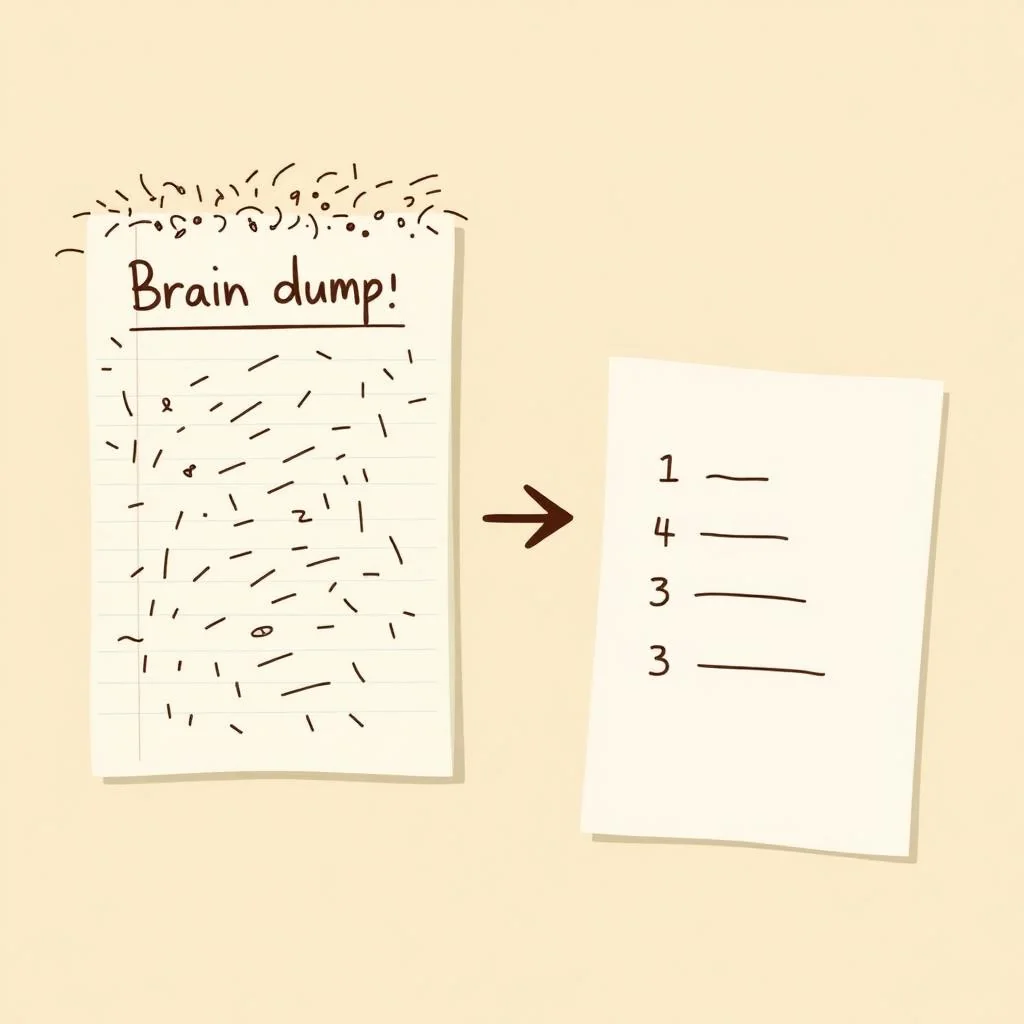
Empty your head in one go and let TaskDumpr split it into sorted, prioritized tasks. No card needed.
Start a free brain dump