
There is a specific moment when a to-do list dies. Not when it gets long. Long lists can still be alive. It dies the day you open it, feel your stomach drop, and close it again without reading a single item.
You know the list I mean. The one with 47 overdue tasks, some dated last quarter. The one where "book dentist" sits next to "restructure entire client onboarding" like they are the same species. The one you keep meaning to clean up, which has itself become a task you avoid.
Here is the thing nobody tells you: fixing that list feels harder than starting over because it is harder than starting over. Triaging 47 stale items means making 47 separate decisions about tasks you have been dreading for weeks, each one carrying a little charge of guilt. Starting fresh means making one decision.
So make the one decision. Declare to-do list bankruptcy.
But do it properly, with a safety net, so you do not lose the handful of things in that graveyard that actually matter. That is what this post is about.
What to-do list bankruptcy actually is
Task bankruptcy is exactly what it sounds like: you formally acknowledge that the old list is unpayable, you stop trying to service the debt, and you start clean. The term has floated around productivity circles for years, usually applied to email. It works even better for task lists, because task lists accumulate something worse than unread messages. They accumulate evidence. Every overdue item reads like a small verdict about the kind of person you are.
That verdict is false, by the way. A list with 47 dead tasks is not proof that you failed 47 times. It is proof that your capture system outlived its usefulness, that priorities shifted, that some of those tasks were never really yours, and that life moved on while the list did not. Lists do not update themselves. Guilt is not a sync feature.
The mistake most people make is treating bankruptcy as deletion. They nuke the list, feel euphoric for a day, then lie awake at 2 a.m. wondering what was on it. That is not a fresh start. That is a new open loop, and your brain treats open loops like unfinished business.
Psychologists have known this for almost a century. The Zeigarnik effect describes how unfinished tasks occupy mental bandwidth in a way completed ones do not. Your mind keeps rehearsing what is incomplete. Delete a list without reviewing it and you have not closed the loops. You have just removed your ability to see them.
So real bankruptcy has two requirements: you let go of the old list, and your brain believes nothing important was lost. Miss either one and it does not work.
When bankruptcy is right: a checklist
Declaring bankruptcy on a list that just needs a Sunday tidy is overkill. Trying to tidy a list that needs bankruptcy is torture. Bankruptcy is the right call if two or more of these are true:
- You have 30 or more overdue items. Past that point, triage costs more than a rebuild. The math simply stops favoring repair.
- You have been avoiding the list for two weeks or longer. A list you will not open is not a productivity system. It is a haunted house you pay rent on.
- You keep rewriting the list instead of doing it. If your main interaction with your tasks is migrating them to a new notebook, app, or format, you are managing the artifact, not the work.
- You cannot tell what is real anymore. Some items are done but unchecked. Some are obsolete. Some you do not even recognize. The list has lost its authority as a source of truth.
- The list makes you feel worse, not clearer. The entire point of writing things down is relief. When the tool reliably produces dread instead, the tool has failed at its one job.
If that sounds like your list, stop patching. Here is the four-step version of bankruptcy that keeps what matters.
Step 1: archive the old list, do not delete it
Export it, screenshot it, or copy it into a document titled "Old list, retired [today's date]." Then put it somewhere out of sight but findable.
This step feels bureaucratic. It is actually the load-bearing wall. Research by Roy Baumeister and E.J. Masicampo, published in 2011, found that unfinished tasks stop intruding on your attention not when they are completed but when your brain trusts there is a plan for them. Completion is optional. Credible handling is not. An archive is the plan. It tells the anxious part of your mind: nothing was destroyed, everything is retrievable, you can stand down.
You will almost never open that archive. That is fine. Its job is not to be read. Its job is to make deletion panic impossible so the next step can actually work.
One rule: do not review the archive as you make it. No skimming, no "let me just rescue a few." That is triage sneaking back in through the window. Copy, close, done.
Step 2: do a fresh brain dump of what is actually alive
Now, with the old list safely in cold storage, open a blank page and ask one question: what is actually on my mind right now?
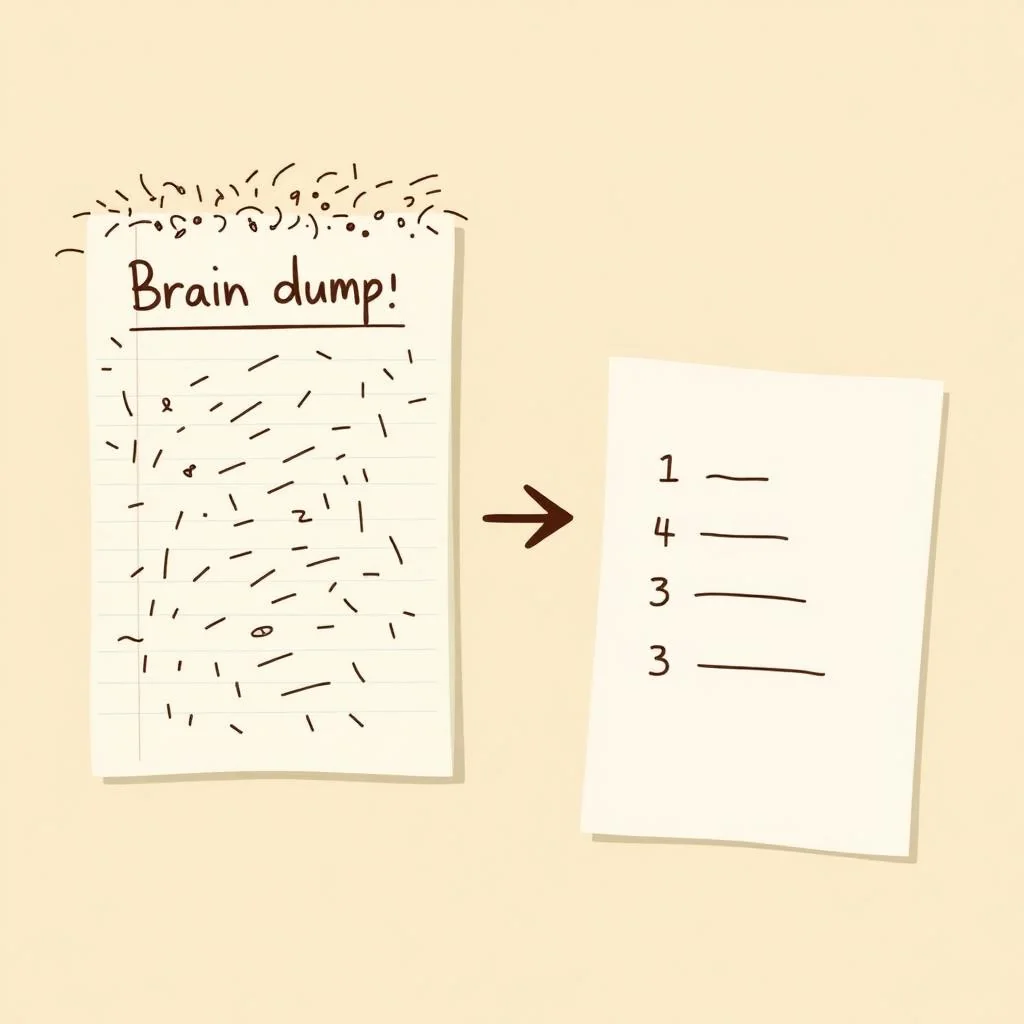
Not "what was on the old list." Not "what should a responsible person be tracking." What is genuinely alive in your head today: the deadline you are worried about, the call you keep meaning to make, the thing you promised your kid, the idea that will not leave you alone. Speak it or type it, unfiltered and unsorted. If you have never done this before, brain dumping is the practice of emptying your head without editing, and it is the fastest way to find out what you actually care about.
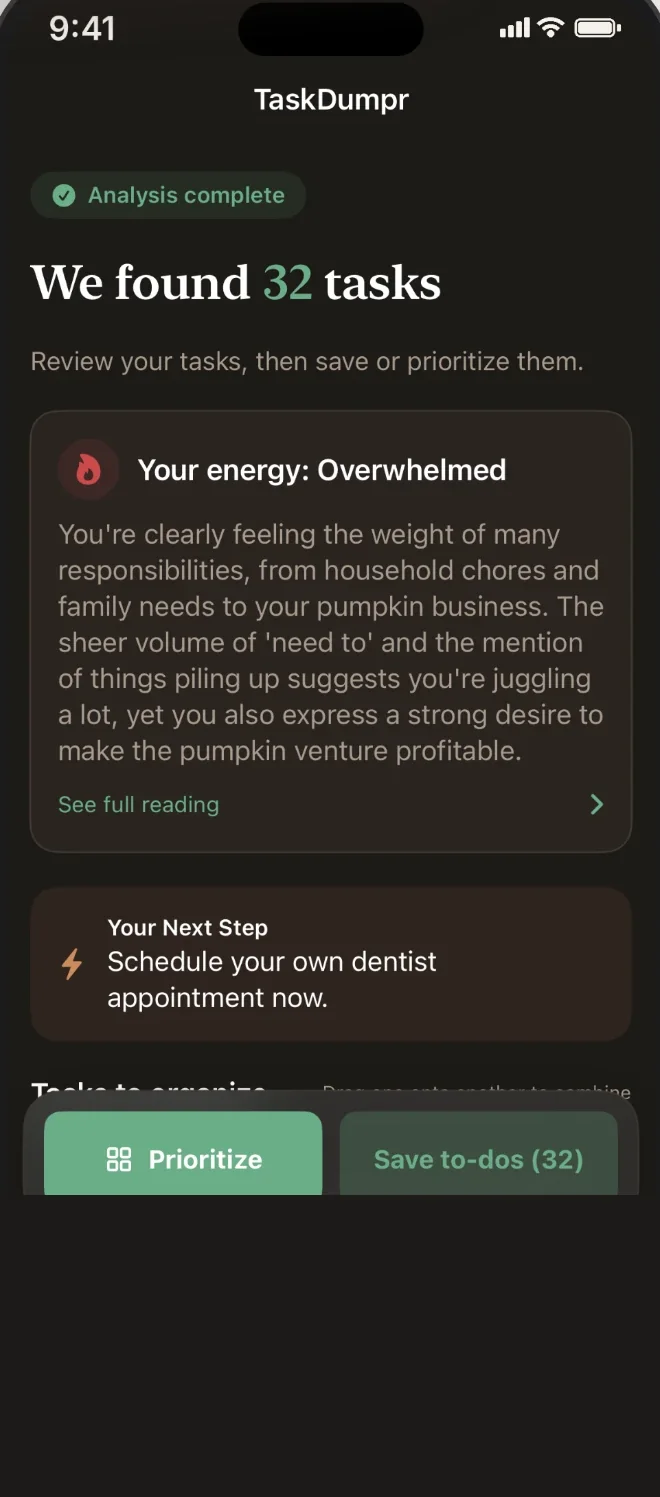
This is where TaskDumpr earns its place in the process. It is a brain dump app for iPhone and the web, built for exactly this moment: you dump everything by voice or text, no structure required, and it handles the organizing afterward. It is deliberately not a project manager, which matters here. You do not want a new filing cabinet yet. You want a clean container for what is real.
Here is the quiet magic of this step: what resurfaces from memory was real. If a task from the old list still matters, it will show up in your dump without any prompting, because things that matter do not need a list to survive. They live in you. What does not resurface was finished, expired, or never yours to begin with. Your memory just performed the triage that felt impossible, and it did it in ten minutes, for free.
Step 3: sort the survivors
A raw dump is relief, but relief without structure decays back into a pile. So sort what surfaced. The Eisenhower Matrix is the cleanest frame for a post-bankruptcy list: what is urgent and important gets done first, what is important but not urgent gets scheduled, what is urgent but not important gets delegated, and what is neither gets eliminated.
TaskDumpr sorts your dump into those four quadrants automatically, then lets you drag anything that landed in the wrong place. Ten minutes after bankruptcy, you have a short, honest list where every item earned its spot by being remembered. That is a very different feeling from a list where every item is a fossil.
Keep the new list small on purpose. A rebuilt list with 60 items is just the old list with better lighting. If everything is a priority, you have recreated the mental load you just escaped.
Step 4: formally release the rest
The archive holds everything you did not carry forward. Most of it needs no ceremony. But there are usually two or three items that need to be released on purpose: the course you never finished, the side project that quietly died, the favor you said yes to in a different season of your life. These are not tasks anymore. They are weights.
Say goodbye to them explicitly. Write a sentence about why you are letting each one go. TaskDumpr has a Let Go feature built for exactly this, a space to release what no longer serves you rather than pretending you will get to it someday. The free plan includes 3 brain dumps and 3 Let Go sessions a week, which happens to be precisely the toolkit a bankruptcy requires. If guilt shows up during this step, and it will, be kind to yourself. Abandoning a dead task is not quitting. It is accounting.
The reframe
You are not behind on 47 things. You are current on the twelve things that are real, and you finally have the paperwork to prove it.
Declaring to-do list bankruptcy is not admitting failure. It is refusing to keep paying interest on debts you never actually owed.
If this cycle keeps following you from app to app, read why you abandon every to-do app. The problem may not be your commitment. It may be the maintenance the tool keeps demanding.
Keep reading
Try TaskDumpr free
Empty your head in one go and let TaskDumpr split it into sorted, prioritized tasks. No card needed.
Start a free brain dump